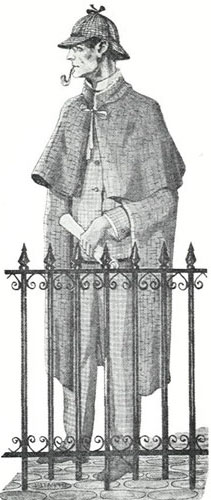
The Adventure of The Three Red Dwarfs
“In Re: Sherlock Holmes”: The Adventures of Solar Pons, 1945
Date - Early May, 1928
The Case
Writers O.K.. Brighton and Gerald Lane shared lodgings. Lane was found stabbed in the heart with his own stiletto and with bruises on his neck and wrist. Jamison suspects suicide: Pons and the coroner believe it is murder. Brighton said that he had been out back in the garden when Lane died, found the body and called the police. Flustered, he painted three of Lane’s dwarf figures red while waiting for the authorities.
Quotes
Ø It was a foregone conclusion that the possibility of an adventure with Pons took precedence over anything else I might have in mind. (Parker’s narration)
Ø Pons: You have only to use your eyes, Jamison…Those stains on your trousers are obviously bloodstains. The condition of your knees shows you to have been creeping about on the floor.
The fact that you were creeping about on a floor where you stained your trousers with blood suggests that there ha been a murder rather than a suicide, for in the latter case you would not have come to me. If there was so much blood on the floor that you could not avoid it in your examination of the body, I infer that the victim bled profusely, and that in turn leads me to suspect that a knife was used and drawn from the wound.
Comments
Ø This case takes place in the same month as The Adventure of the Black Narcissus. Perhaps Pons’ prompt solving of that case led Inspector Jamison to quickly seek him out at the beginning of this one.
Ø The Three Red Dwarfs is one of the most workmanlike cases solved by Solar Pons. His on-site investigation is impeccable, his observations and deductions are thorough and logical and he utilizes his worktable to find the crucial evidence allowing him to reconstruct the crime. Lacking sensationalistic features, this case is one of the finest examples of Pons’ traditional detective abilities.
Ø
Ø The first quote above is of import to the series as a whole. Constance Dorrington has a much less visible presence in the story than Dr. Watson’s first wife, the former Mary Morton. Holmes had a rather disparaging attitude towards Watson’s connubial state, primarily driven by the impact it had on his own work.
Pons rarely makes reference to Parker’s wife. Parker married Dorrington five years after meeting her (in fact, it was only three to four months after The Three Red Dwarfs). Prior to their wedding, it is likely that Parker was at Pons’ disposal whenever needed, an assertion bolstered by the aforementioned quote. Afterwards, there are no indications that Constance Parker ever stood in the way of her husband’s adventures with Solar Pons. In fact, Parker rarely mentions her.
Ø In The Valley of Fear, Sherlock Holmes remarks, “When water is near and a weight is missing it is not a very far-fetched supposition that something has been sunk in the water.” Another axiom that oft rings true is that when painting has occurred in the proximity of a crime or a missing person, it was done to cover up evidence.
In Holmes’ case of The Retired Colourman, Josiah Amberley paints inside his house to cover up the smell of the gas he used to kill his missing wife and her lover. Paint can change or cover evidence through both smell and sight and is readily available. This makes it ideal in blurring undesirable elements of a crime.
Ø Pons searched a book catalogue that he had deposited in his wastebasket. He paged through it until he found what he was searching for, as reported by Dr. Parker. “Ah,” he murmured at last. “here we have it. ‘Chess…Chess and the Human Mind – A Monograph, by O.K.. Brighton, with a commentary by Gerald Lane.’”
It seems possible that Brighton and Lane’s chess proclivity sparked a mild suspicion of the latter in Pons' mind. At the summation of the case, Pons states, “…the man who wrote the monograph on chess emerged then, and laid elaborate plans to foil an investigation.”
Nine years earlier, Pons had written a monograph, The Chess Problem and the State of Mind. Was there something in Pons’ analysis of the subject matter that led him to analyze Lane and pursue the avenues that allowed him to reconstruct events?
Ø It is interesting to note that Pons strongly suggests that Jamison not arrest the killer, since a capable barrister would easily prove that it was a case of self-defense. Considering that the killer did push a stiletto into the victim’s heart; intentionally tampered with evidence and then lied repeatedly about events, it seems a bit presumptuous of Pons to simply dismiss the entire criminal justice process out of hand.
Return to Adventures Home