
The Adventure of the Black Narcissus
The Dragnet, February, 1929
Date - Early May, 1928
The Case
James T. Rudderford, wanted by the police for murder, bursts into 7B Praed Street. He tells Pons that he has been financially ruined by the failure of the Claybar Mine, which he invested in at the urging of Jackson Deming. Upon discovery of his speculative disaster, he had rushed to Deming’s office, intent on revenge. However, he found the man dead, a knife through his back and a rare black narcissus by his head. Rudderford was seen by the charwoman as he fled the scene and Inspector Jamison believes that it is an open and shut case.
Quotes
Ø Pons: I put it to you, Jamison, that the significance of the black narcissus cannot any longer be avoided. I earnestly suggest that you concern yourself with discovering the meaning of the flower.
Ø I had little business, for my practice had not at that time taken on much significance. (Parker’s narration)
Ø Pons: Ah, well, a difference of opinion adds zest, eh, Jamison?
Comments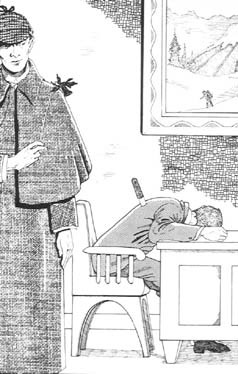
Ø The Adventure of the Black Narcissus holds the pre-eminent spot in the Pontine Canon, for it gave birth to Solar Pons. Having been told by Sir Arthur Conan Doyle that there would be no more Holmes tales, and also denied permission to write more himself, Derleth made a note on a random day in his calendar; “In re: Sherlock Holmes.” When that day arrived, he sat down and in one afternoon and evening, wrote The Black Narcissus. Derleth sold the story to The Dragnet magazine for $40, and it was published in February of 1929.
Ø James T. Rudderford rushes into Pons’ room, lamenting that he is wanted for murder, though he insists that he is innocent. Readers of the Canon certainly must have recognized the similarities to John Hector McFarlane’s visit to Baker Street in the opening of The Adventure of the Norwood Builder.
Ø Pons is wearing a smoking jacket at the story’s beginning and then trades it for a light coat and a waterproof when he goes out. Dr. Parker specifically points out that Pons dons an Inverness when leaving Praed St. in nearly all of the subsequent cases involving his outer wear.
Ø The first comment Pons makes regarding the official constabulary is “Jamison is thorough.” This sets a tone for the Pontine Canon in which Solar Pons generally has a positive attitude towards the police. Contrast that with the first two sentences Sherlock Holmes makes about the police: “Gregson is the smartest of the Scotland Yarders. He and Lestrade are the pick of a bad lot.” Pons has a much less adversarial relationship with the police while on a case.
It is interesting to note that the police frequently seem to comply with Pons’ requests as if they were orders. He tells Jamison “Furthermore, you can oblige me by coming around when your notice is answered.” The Inspector says that he will do it. The Pontine Canon is replete with unquestioning obedience by the police, indicating that Pons engenders much less resentment than Holmes did.
Ø Expanding upon the previous point, Pons established his private practice in 1907. Sir Edward Henry and Sir William Horwood were Commissioners at Scotland Yard for the first 21 years of Pons’ practice (discounting his World War I service as a code breaker). Bancroft Pons was 34 years old and presumably a man of at least modest import within the government when his younger brother started his detecting career. Did Bancroft use his position to somehow influence upper-level Scotland Yarders to be receptive to Pons’ investigations and cooperate where possible?
Ø Pons explains to Jamison that the lack of specific footprints in Deming’s inner office establishes Rudderford’s innocence. Footprints would play a key role in several of Pons’ cases.
Return to Adventures Home