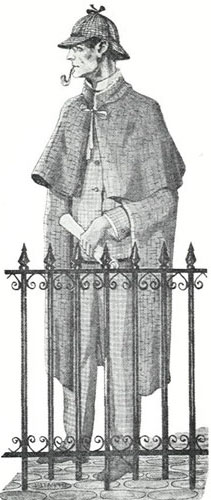
The Adventure of the Late Mr. Faversham
Date - Late April, 1928
The Case
Shortly after withdrawing 10,000 pounds from Merk College’s bank account, where he was treasurer, Professor F.V. Faversham walked into his house and completely disappeared. All possible entrances to the house but the front door were boarded up and that one was under observation by a fellow professor. Faversham had openly withdrawn the money and was to return it one day before taking an extended leave of absence in Berlin. Pons is hired by the College to find Faversham and recover the money.
Quotes
Ø Pons: Well, one of two solutions presents itself. Faversham either went out this door, or he did not.
Ø Pons: There is a great difference between sleeping once and five times in a bed, as the sheets and the impressions will quickly reveal to a careful observer. The single impression is consistently clear, the outlines usually quite plain, the sheets rumpled only in the places where you lie; but a number of impressions will produce a blurred and broadened rumpling and outline.
Comments
Ø The Late Mr. Faversham was either the third or fourth Pons tale to be published, the first two being The Adventure of the Black Narcissus (February, 1929) and The Adventure of the Broken Chessman (September, 1929). The confusion arises because Detective Trails published The Adventure of the Limping Man the same month as Fave appeared in Dragnet.
Ø This tale has its roots in an unpublished Sherlock Holmes case from Watson’s chronicles. In The Problem of Thor Bridge, the good doctor mentions Mr. James Phillimore, who stepped back into his own house to get his umbrella and was never heard from again.
Ø In this recounting, Parker himself references two cases that he would later publish (The Sotheby Salesman and The Black Cardinal), as well as an unpublished one (The Mumbles, or The Swansea Mystery).
Ø Constable Mecker is on the case for Scotland Yard. He appeared in the very first Pons story, The Black Narcissus, assisting Inspector Jamison.
Ø Pons hints to Parker that an inscribed book of poetry by Dr. Hans Von Ruda, the witness in the disappearance, is of importance. Parker does not find the clue. When Pons asks, “You noticed nothing else?” the reader senses his amusement at Parker’s failure to glean what the detective has learned from the book.
Rather than make his point, Pons simply tells him that he will address the book later. While Pons is more complimentary of Parker’s attempts at deduction than Holmes was of Watson’s, still the great detective oft kept Parker (and the reader) in suspense. While this is an essential element for the public, it must certainly have worn on Parker’s nearly limitless patience.
Return to Adventures Home