The Adventure of the Sotheby Salesman
Date - Mid August, 1920
The Case
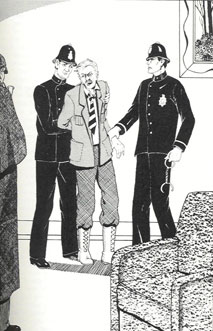
Inspector Jeremy Hudson of Aldershot telegrams Pons and requests his assistance. Peter Woodal, a local salesman, was found shot in an empty house owned by the next-door neighbor. Pons deduces from an open window and further examination that the killer arranged a meeting, waited over an hour for Woodal to enter the house and then shot him with a rifle. Pons searches for clues as to the reason for a rendezvous at an empty house.
Quotes
Ø Well, I daresay speculation is idle. Let us wait until we reach the scene before we search for conclusions.
Ø Having completed this scrutiny, he took up the lamp and, holding it aloft in one hand, crept around and around the body in ever-widening circles. At intervals, he placed the lamp on the floor, in order to scrutinize anything that might catch his eye. It was an hour before this process was completed, but at last Pons rose and gave the lamp to one of the constables. (Parker’s narration)
Comments
Ø This is the earliest case for which Parker wrote up a full story. It was also the second one published, after The Adventure of the Black Narcissus.
Ø Pons is most impressed with Hudson, saying that the inspector’s mind is promisingly acute and that the problem must be interesting if he referred it to Pons.
Ø Upon arrival at the scene, Pons almost immediately inquires about possible footprints. As seen throughout the Pontine Canon, Pons rated footprints as perhaps the most important piece of evidence in reconstructing a crime.
Ø Pons tricks a suspect into writing a seemingly innocuous note that includes key words contained in a note found at the scene of the crime. Either Pons is extremely persuasive or he encounters quite a few bumpkins in his cases, since several people readily agree to provide him with handwriting samples.
Ø Why did William Hendricks not explain that he was a cuckolded husband? Was he afraid that is wife-beating would be exposed? Adultery by a female was still a mitigating factor in British society in the nineteen twenties. Might Hendricks have received a more lenient sentence if this element was entered by his defense? It is implied that Hendricks was hung for killing Woodall. His widow married Jonathan Green a year later. Surely, if Hendricks beat his wife and tried to murder Green, he would not simply remain quiet and accept a death sentence, freeing his wife and her lover from his tyranny and revenge?
Return to Adventures Home