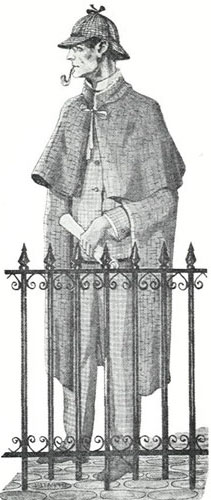
Foreword, In Re: Sherlock Holmes…The Adventures of Solar Pons
Vincent Starrett, 1945
“In Re: Sherlock Holmes”: The Adventures of Solar Pons, 1945
AS A BOY, August Derleth couldn’t get enough Sherlock Holmes stories; there were not enough of them in the world to satisfy his craving for the society of the fascinating disentangler of Upper Baker Street. When he had read them all, many times over, and being then nineteen years of age, he wrote to Sir Arthur Conan Doyle setting forth his reasonable complaint. Are you, or are you not, he courteously asked the great storyteller, going to write any more stories about Sherlock Holmes?
Sir Arthur made no promises in his good-humored reply; so there and then young Mr. Derleth determined to carry on the tradition himself. A desk calendar stood at his elbow; he stabbed a finger into its pages at random and scribbled a note to himself: “In re-Sherlock Holmes.” On that day, when it should have arrived, he told himself, he would write a story in imitation of the Master.
The precise date of this impatient episode is lost to literary chronicle with the memorandum; but Derleth was attending the University of Wisconsin at the time, and when the day came he did actually sit down and write The Adventure of the Black Narcissus, which you find in this book. I don’t know how he hit on the name Solar Pons – probably he considered a lot of names before he found one that pleased him. The story was sold immediately, however, to Harold Hersey, and published in The Dragnet magazine, a development that inspired the youthful author to new feats of imitation. There followed in rapid succession the adventures of The Missing Tenants, The Broken Chessman, The Late Mr. Faversham, The Limping Man and The Black Cardinal. On one red-letter day, a day of gilt and glory, the young man dashed off three Solar Pons adventures at a sitting and two of them survive in this collection, The Norcross Riddle and The Three Red Dwarfs.
That is the true story of the birth of Solar Pons; he was – as it were – an ectoplasmic emanation of his great prototype, and his adventures are pure pastiche. As such we acknowledge them gratefully. By we, I mean those frantic and incurable Sherlockians who, with August Derleth, deplore the paucity of Canonical entertainments and view without alarm the mounting uproar of our hero’s triumph, which already had called forth so garrulous a stream of apocryphal recollections. It is impossible not to wonder about those many untold tales half-promised by the exasperating Watson; and it is the obvious duty of writers with information concerning them, or with other adventures to relate, to give them to the world. No doubt we should rather have more of the great originals, but we accept the imitations, faute de mieux, to satisfy a normal appetite. And we accept them with enthusiasm. They are the work of affectionate minds and hands. There is no intention to deceive. These stories, and others in their field, are intended only to please. They are nostalgic reminders of vanished days and nights in Baker Street.
The scheme of Derleth’s “sequels” is more than just a little reminiscent; it is frankly borrowed. Dr. Lyndon Parker returns to London just in time for this book to become possible. Solar Pons, the “Sherlock Holmes of Praed Street,” is even then looking about him for some amiable fellow to act as his Watson; he loses no time in persuading the doctor to share the Pontine lodgings. Their meting is right out of A Study in Scarlet:
“Fine color,” says Pons crisply, coming to a stand beside the doctor’s restaurant table. “Not long back from Africa, I see.”
“Two days.”
“Your scarab pin suggests Egypt, and, if I am not mistaken, the envelope on which you have been writing is one of “Shepheard’s.”
He is not mistaken, you may be sure; and almost immediately the game is afoot. One comes upon the rest of the cast, from time to time, without surprise. Mrs. Johnson is their estimable and “long-suffering” landlady, and Baron Ennesfred Droll, that “arch-criminal” whose hand Pons does not fail to recognize in several adventures, makes an admirable Professor Moriarty. The “Baker Street Irregulars” too, are in at least one of the tales (not the Morleian conversation club, but the original gamins), and so is the collection of scrapbooks, whose indexing still goes forward. One is happily moved by some of the reminiscent story-openings; for example, this one:
When I look over my notes on the cases that engaged Solar Pons’ attention during
the decade begun in 1919, I find many amazing adventures whose details ought to
be placed before the public.”
And there is some of Watson’s effective and annoying trick of mentioning “other cases” unrecorded in the volume at hand. These include “the perplexing affair of the Mumbles, known to the public for many months as the Swansea Mystery,” and “that unbelievable conspiracy which threatened to undermine the Papacy and overthrow half the governments of Europe.” Perhaps Derleth intends to tell us more about these little matters some other time – although that “unbelievable conspiracy” sounds a bit like what the war correspondents have been telling us for a number of months.
One likes the author’s trick of using the exact words and phrases of the original saga, when it suits his purpose, and greets with a smile of pleasure such familiar lines as
“Dark waters, Parker, dark waters!”
“Come Parker! The game is afoot.”
“’Elementary,’ I said.” (A nice touch, that, to hand the familiar word to Parker.)
As to the stories Derleth has imagined, some are better than others, which was true also, I seem to recall, of the stories written by Sir Arthur Conan Doyle. My own favorite is The Adventure of The Late Mr. Faversham, largely, I think, because it is a satisfying telling of one of the tales Watson once promised to tell and never told. I had often wondered profoundly about the incredible mystery of Mr. James Phillimore, who, stepping back into his own house to get his umbrella, was never seen in this world,” one of Watson’s most provocative hints. Ellery Queen had a go at this problem too, as readers of The Misadventures of Sherlock Holmes are aware; so now we have two versions of the incident, and I hope everybody is happy. The “deduction” involved in this episode in the career of Mr. Solar Pons seems to me in best tradition; but, indeed, there is a lot of quite plausible deduction in all these tales. Note particularly that in the first part of The Adventure of the Norcross Riddle.
Although these stories by August Derleth are frankly and seriously intentioned pastiches, I wonder if I am right in thinking I find in them a hint – just a mild flavor – of burlesque. Or is something of the sort inevitable in any imitation? Just the faintest suggestion of a tongue in the auctorial cheek is all I am supposing, and perhaps I am imagining it. But I hope not, and I don’t think so, for it seems to me the best pastiches must have just hat remote savor of affectionate spoofing.
Solar Pons is not a caricature of Sherlock Holmes. He is, rather, a clever impersonator, with a twinkle in his eye, which tells us that he knows he is not Sherlock Holmes, and knows that we know it, but that he hopes we will like him anyway for what he symbolizes.
Return to Adventures Home